01
A website that books.
Clear pages for what you offer, who it’s for and how to start, with online booking and intake built in. New clients can go from reading about you to a time on your calendar without a phone call.
Industries · Holistic health
Westhampton Beach, New York
Websites and marketing for holistic health and wellness practices, from health coaches and nutritionists to acupuncturists, chiropractors, studios and wellness centers. We build the site, the booking, the shop and the local search presence a practice runs on, and we write it within the rules on health claims and testimonials. On Long Island and anywhere in the US. Starter sites from $1,000, custom sites from $2,500.
01 /What we build
Take one piece or all six. Each one is built to work with the others.
Clear pages for what you offer, who it’s for and how to start, with online booking and intake built in. New clients can go from reading about you to a time on your calendar without a phone call.
Supplements, recipe bundles, gift cards and programs on Shopify, linked to your main site. You manage products yourself once it’s live.
Local SEO and a Google Business Profile set up properly: the right categories, services, hours and photos, and a steady way to ask every client for a review that stays inside Google’s rules.
When someone asks ChatGPT or Google’s AI who to see for acupuncture or nutrition coaching, the answer names a few practices. AI search optimization makes yours easy to find, verify and cite. It’s included in our SEO.
You can’t answer the phone mid-session. An AI receptionist answers, books and takes messages, including after hours, and texts back anyone who hangs up.
A newsletter, a welcome sequence for new sign-ups, and launch emails for programs and workshops. Email marketing set up in your own account, so the list stays yours.
02 /Built for how a practice sells
Plenty of wellness clients read for a while, book a short call, and only then commit. The site is built around that path.
03 /Compliance, plainly
Health marketing has more rules than most. These are the ones that touch your website, your reviews and your ads, and how we handle each one.
| Topic | What the rule says | On your site |
|---|---|---|
| Health claims | The FTC’s Health Products Compliance Guidance (December 2022) covers supplements and other health-related products. Health claims need competent and reliable scientific evidence, and the FTC generally expects high-quality randomized, controlled human clinical trials. | We describe your services and products without promising outcomes, and flag any claim you’d need evidence to make. |
| Testimonials | Under the FTC’s Endorsement Guides, if a client’s results aren’t what people generally achieve, the ad must make clear what the generally expected results are. “Results not typical” isn’t enough. A 2024 FTC rule bans fake reviews and testimonials, including ones from people who don’t exist or didn’t have the experience. | Real clients, with permission, and a typical-results line where one is needed. |
| Google reviews | Google prohibits paying or offering incentives for reviews, and selectively asking only happy customers. | One review request to every client, with no discount or gift attached. |
| HIPAA | HIPAA applies to health plans, clearinghouses and health care providers that electronically transmit health information in connection with standard transactions, such as insurance claims. HHS says using email alone doesn’t make a provider a covered entity. | If you are covered, patient data goes through HIPAA-ready tools, not website forms or ordinary email. If you aren’t, we still keep forms short. |
| Health data and ads | In 2023 the FTC finalized an order requiring online counseling service BetterHelp to pay $7.8 million, over allegations it shared health questionnaire answers with Facebook and others for advertising. Google Ads bars advertiser-curated audiences, like remarketing lists, when promoting personal health content. | No ad pixels on intake or booking pages, and no ad audiences built from health interest. |
| Google Ads | Google’s healthcare and medicines policy prohibits ads for supplements with active pharmaceutical or dangerous ingredients, products on its unapproved substances list, and speculative or experimental medical treatments. Some categories, like prescription drugs, need certification. | We check products and landing pages against the policy before any ad runs. |
| Accessibility | The Justice Department’s position is that the ADA applies to the web offerings of businesses open to the public. It has no regulation setting a technical standard for them, and points to the Web Content Accessibility Guidelines (WCAG) as helpful guidance. | We build to WCAG 2.2 Level AA, the current W3C version. |
| Text messages | FCC rules under the TCPA require prior express written consent for autodialed texts that advertise or telemarket. | Clear opt-in wording on forms, and an easy way to opt out. |
This is general information about published federal rules and platform policies, not legal advice. Sources are listed at the bottom of this page. Check anything specific to your practice with a qualified attorney.
04 /Our work
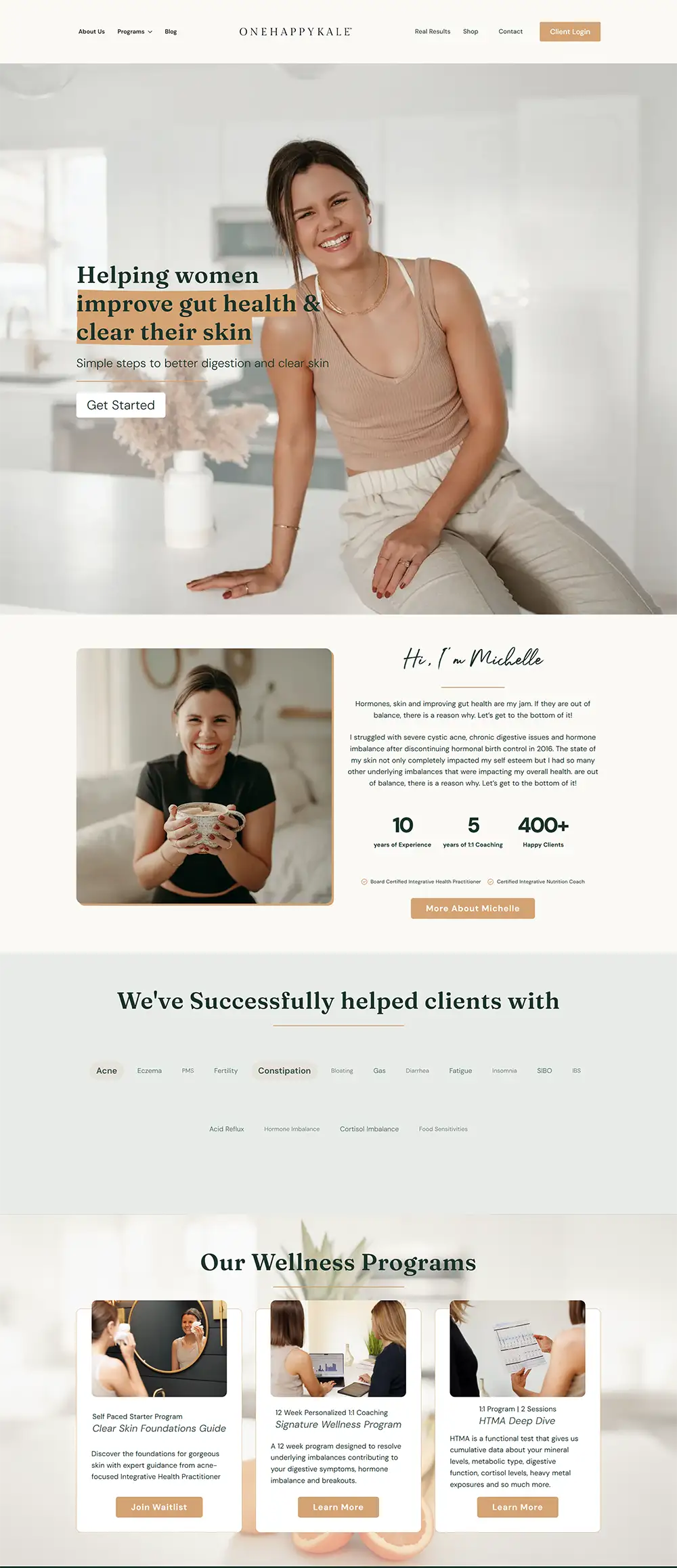
A real coaching practice, on a custom WordPress site we built.
Health coaching · Custom WordPress site
We built One Happy Kale a custom WordPress site for its health-coaching practice: a home page that explains the approach, a landing page for each program, and clear next steps for a reader who is ready to book. The team updates pages and posts on its own.
05 /Pricing
Every price here is where a project starts. You get a written quote after a short call.
| Service | What’s included | East End Web |
|---|---|---|
| Starter site | A five-page, SEO-optimized WordPress site. Extra features, customizations and premium plugins cost more. | From $1,000 |
| Custom site or redesign | Designed around your practice, with booking and intake built in, quoted line by line after a discovery call | From $2,500 |
| Shopify store for supplements or programs | Theme-based store, up to about 25 products loaded, payments, shipping and tax, policy pages, basic SEO and a walkthrough | From $2,000 |
| Managed hosting | Hosting, backups, security and uptime monitoring. Edits and new features are quoted separately. | From $50 a month |
| Local SEO | Ongoing local search work with AI search optimization included, quoted after a free audit | From $500 a month |
| Google Business Profile setup | Categories, services, hours, photos and description filled in and optimized | From $500 |
| Google Business Profile management | Ongoing posts, photos, review requests and responses | From $300 a month |
| AI receptionist | Answers calls, books and takes messages, with missed-call text-back included. The final price depends on call volume and what it handles. | From $200 a month |
| Email marketing | Newsletters and program emails on your own account, with automations kept running. Setup from $500. | From $300 a month |
| Landing page | One page for one program, workshop or offer | From $750 |
Every price is a starting point. The final number depends on what your practice needs, and you get it in writing after a short call. Payment plans are available on many projects. All our pricing ↗
06 /Common questions
Still have one we haven’t answered? Just ask.
Yes, anywhere in the US. We’re based in Westhampton Beach, New York, and we’ve built for holistic health practices in several states. Most of a project runs over video calls and email, so where you’re located doesn’t change how we work.
Yes. Our Shopify starter is from $2,000: a theme-based store with up to about 25 products loaded, payments, shipping and tax set up, policy pages, basic SEO and a walkthrough. Programs and packages can sell from the same store or from a page on your site. Product descriptions still have to follow the FTC’s rules on health claims, so we keep the copy to what you can back up.
A starter site is from $1,000: a five-page, SEO-optimized WordPress site, with extra features and premium plugins costing more. A custom site or redesign is from $2,500, quoted line by line after a discovery call. Adding a Shopify store is from $2,000, and managed hosting is from $50 a month.
Yes. We connect the scheduling tool you already use, such as Calendly, Acuity, Jane or SimplePractice, or help you pick one, so clients can choose a time, get confirmations and fill in intake forms without a phone call. Where your scheduler supports it, clients can also pay or leave a deposit when they book.
It depends on whether your practice is a HIPAA covered entity. HHS says HIPAA applies to health plans, health care clearinghouses and health care providers that electronically transmit health information in connection with standard transactions, such as insurance claims, and that using email alone doesn’t make a provider covered. Many coaches and studios that don’t bill insurance aren’t covered, but the FTC can still act against businesses that misuse health data. This is general information, not legal advice.
Sources
Checked September 28, 2026. General information, not legal advice.
Free audit
Start with a free website and online-presence audit. We’ll look at your site, your Google profile and what AI answers say about you, then walk you through what we’d fix first. No pressure, no jargon.